

Thought Leadership
Beyond the Bracket: What the NCAA Championship Teaches Us About Fundraising and Brand Value

It’s Monday, April 6, 2026, and if you’re anything like me, you’re probably running on six hours of sleep, a little too much iced coffee, and the leftover emotional damage of a bracket that got humbled days ago. And yet, here we are. Still watching. Still yelling at screens. Still pretending we always believed in that underdog run.
At Bridge Philanthropic Consulting (BPC), we spend our days examining how philanthropic capital moves: where it flows, where it stalls, and who gets to make the decisions once the money lands. So while everybody else is breaking down the last possession, I’m over here looking at the bigger playbook.
Because the NCAA Championship is not just about basketball. It’s about attention, Fundraising, momentum, brand power, donor behavior, institutional strategy, and who knows how to turn a big moment into long-term advantage. In plain English: this is sports, yes. But it is also corporate sponsorships, fundraising, and donor engagement.
WE ARE WATCHING A WHOLE PHILANTHROPIC CAPITAL STORY PLAY OUT IN PUBLIC, AND HONESTLY, IT’S WILD.
The $1.5 Million Commercial: The Women’s Game Is Not “Emerging” Anymore
LET’S BE VERY CLEAR: THE WOMEN’S GAME ISN’T ASKING FOR PERMISSION ANYMORE.
For years, people talked about women’s sports as if it were some nice little future opportunity. A “wait and see” situation. A maybe. A someday. Meanwhile, the audience was already there, the talent was already there, and the culture was already there. The capital was just late to the party.
Now look at the board.
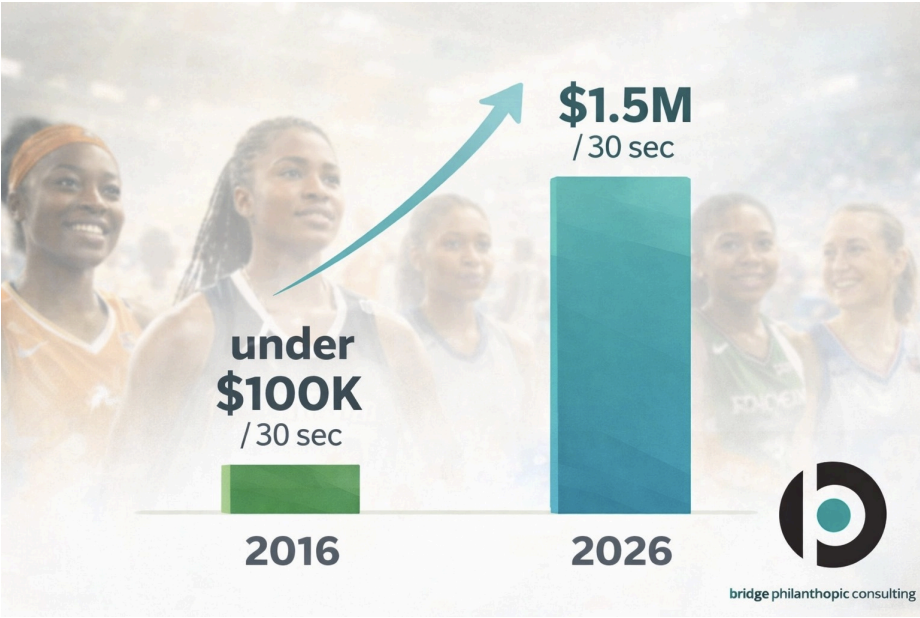
- In 2026, a 30-second ad spot around the Women’s Final Four is $1.5 million
- Roughly a decade ago, that same kind of visibility was going for less than $100,000
- That is not a bump
- That is not a nice trend line
- That is a market correction with receipts
When we talk about equity-centered capital strategy, this is exactly what we mean. Funding follows what the market when the market demonstrates impact and opportunities to scale.
As Dwayne Ashley, CEO of Bridge Philanthropic Consulting, puts it: “Winning isn’t about the last shot; it’s about the capital system that put the ball in their hands.”
That’s the whole point. The scoreboard matters, sure. But the capital system behind the scoreboard matters more. At BPC, with more than 800 years of combined experience and more than $2 billion raised for clients, we’ve seen this same pattern across philanthropy, higher education, and social impact work around the world:
- talent gets noticed late
- institutions fund what feels familiar
- and once the money finally moves, everybody acts surprised by the results
No surprise here. If you back excellence like excellence, it tends to perform like excellence.
The UConn Strategy: Bet Bigger on What Actually Works
HERE’S THE PART CFOs, PRESIDENTS, AND BOARD CHAIRS SHOULD NOT MISS.
UConn did not become UConn by spreading money around like parsley. They got serious about what they were world-class at and invested accordingly.
The math tells the story. UConn put roughly $34 million into basketball while football sat closer to $20.5 million. In a sports culture where football usually gets treated like royalty, that is a pretty bold call. But it was also a smart one. They looked at their strongest asset, saw where the return could be greatest, and leaned in.
That lesson travels well beyond athletics.
Too many nonprofits, universities, and civic institutions try to be all things to all people. Ten priorities. Twelve initiatives. Fifteen urgent needs. One tired development team. That is not strategy. That is budget anxiety with a mission statement.
What we’ve learned, helping clients navigate their hardest problems, secure prospect meetings, guide strategy, and close gifts with UHNW prospects, is simple:
- not every asset deserves the same level of investment
- not every program should carry equal weight
- and not every legacy model is worth protecting
If you know where your excellence lives, fund it like you mean it.
The “Flutie Effect” and Why Winning Makes Everybody Generous
MOMENTUM CHANGES PEOPLE. ESPECIALLY DONORS.
If a school wins big on Monday, by Tuesday, somebody in advancement is smiling at a dashboard. That’s the Flutie Effect: the long-observed pattern where athletic success can drive a jump in applications, visibility, alumni pride, and yes, donations, especially larger alumni giving.
And no, this is not just sports folklore. The pattern is real enough that institutions have been chasing it for decades. Win big, get attention, and suddenly, alumni remember their password to the giving portal.
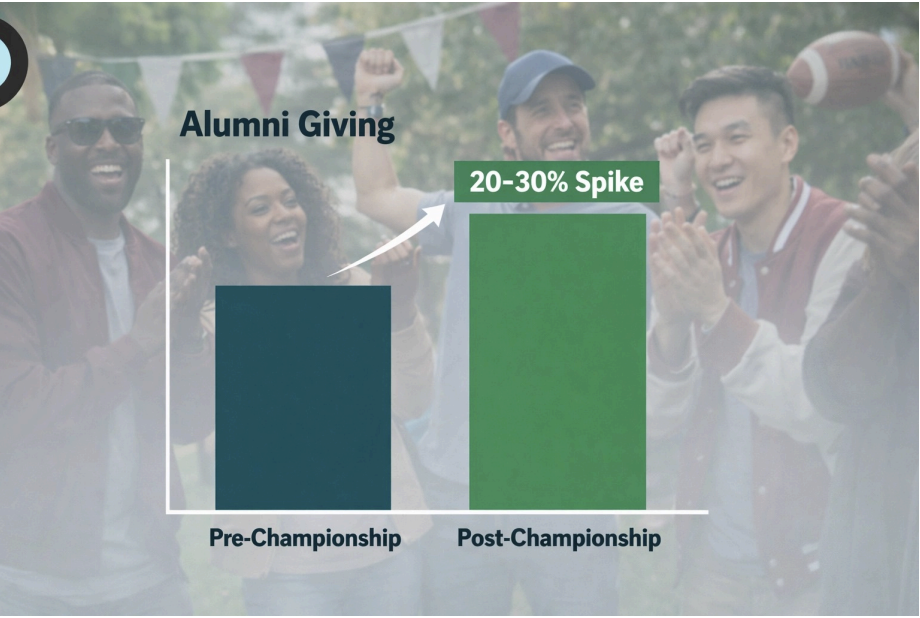
A 20–30% spike after a championship is the kind of thing that gets everyone excited, and I get it. Winning creates emotion. Emotion creates action. Action creates gifts.
But here’s the sports-bar-with-a-master’s-degree version of the truth: if your whole fundraising plan depends on cutting down nets, you do not have a fundraising plan.
At BPC, we use moments like this differently. With more than 800 years of combined experience and more than $2 billion raised, we know how to help organizations turn a headline moment into something durable:
- stronger donor pipelines
- smarter follow-up strategy
- better qualification and cultivation
- and long-term revenue resilience instead of one hot week
That’s the real play. Not just catching the wave, but building a structure that still works after the crowd goes home.
NIL and the Donor Concentration Problem Nobody Should Ignore
LET’S TALK ABOUT THE BOOSTERS, THE BIG CHECKS, AND THE VERY FRAGILE HOUSE OF CARDS.
NIL changed college sports fast. It created new opportunities for athletes, new money paths for schools, and a whole new layer of competition. But it also put a spotlight on a problem we talk to clients about all the time: donor concentration risk.
Right now, a small number of states, conferences, and power networks control an outsized share of NIL money and adjacent philanthropic capital. That means influence and access are concentrated, and outcomes start looking awfully predictable.
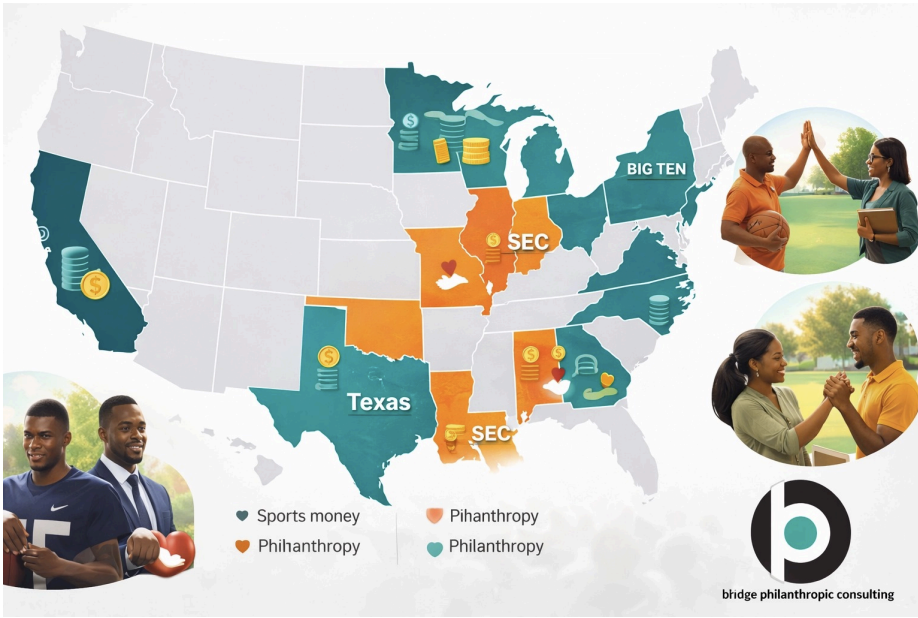
Here’s the lesson for nonprofits, universities, and mission-driven institutions: if too much of your future depends on a few donors staying in a good mood, that is not stability. That is exposure.
We work with clients every day to reduce that kind of risk by helping them:
- secure prospect meetings with the right funders
- build smarter revenue architecture
- guide strategy for major and transformational gifts
- and close gifts with UHNW prospects without overbuilding dependence on any one source
As one industry leader often says, in so many words, sports is just philanthropy in a jersey. If you don’t redesign the revenue architecture, the same teams and the same charities always win.
And Birgit Smith Burton has long reminded the sector that philanthropy is about more than the check itself; it’s about the movement behind it. She’s right. Broad-based support is slower to build, but it is much stronger when conditions change.
THE BPC DIFFERENCE: WE DON’T JUST WATCH THE GAME, WE STUDY THE MONEY
WE ARE NOT JUST COMMENTING FROM THE SIDELINES.
Bridge Philanthropic Consulting was built for organizations that need more than motivation. They need structure. They need strategy. They need someone who understands both how money is raised and how power actually works once it arrives.
That’s where we come in.
With more than 800 years of combined experience and more than $2 billion raised for clients, we partner with institutions that care about real social impact in communities across the country andaround the world. Our work is not theoretical. It is practical, high-level, and built for leaders trying to solve serious problems.
We do all of that with one eye on immediate opportunity and the other on long-term sustainability. Because a great campaign is nice. A durable capital system is better.

HERE’S MY LAST TAKE BEFORE TIP-OFF TONIGHT.
When the confetti falls, most people will talk about coaching, heart, grit, and who wanted it more. Fair enough. But the sharper question is this: what capital system made that win possible in the first place?
That’s the question we ask every day.
If the same institutions keep getting the same advantages, we should not be shocked when they continue to produce the same outcomes. The lesson from March Madness is not just that winning matters. Its stewardship and donor cultivation are still the key to success.****
That’s the work.
If you’re ready to move beyond a one-season boost and build something durable, we’d love to talk. Visit www.bridgephilanthropicconsulting.com to learn how we can help your organization secure prospect meetings, strengthen strategy, close transformational gifts, and build a capital approach that actually fits the future you say you want.
BPC adheres to the highest ethical standards in its work as members of the Association of Fundraising Professionals, Association of African-American Development Officers, and the Giving Institute.

Download The Free BPC Capital Campaign Guide
Running a capital campaign can be a game-changer for your non-profit organization. This comprehensive guide dissects the process and offers expert advice to help you prepare for a successful capital campaign.

