

Thought Leadership
When the World Comes to Play
The 2026 FIFA World Cup is the largest sporting event ever staged on North American soil — and the most generous to the communities that host it. This briefing celebrates that achievement: where the philanthropic capital is flowing, the neighborhoods it is lifting, and how funders and nonprofit leaders can carry the momentum forward.
A month of football, a generation of community legacy
On June 11, the tournament opened in style with Mexico defeating South Africa 2–0 in Mexico City. Over the next five weeks, 48 teams will play 104 matches across the United States, Canada, and Mexico — and for host communities, the celebration extends far beyond the stadiums into local economies, youth programs, and neighborhoods energized by the world’s game.
What makes 2026 special is intention. A FIFA–WTO study modeled the event’s social return alongside its economic one, projecting up to $40.9 billion in added GDP across North America, roughly 824,000 full-time-equivalent jobs globally, and an estimated $8.28 billion in social benefits — the first time a men’s World Cup has been measured this way. This is a legacy designed in advance, with communities at the center.
A powerful celebration of unity, diversity and shared passion.— Gianni Infantino, FIFA President
That spirit is the opportunity. The tournament hands host communities a once-in-a-generation platform — and a wave of goodwill, investment, and giving that thoughtful philanthropy can turn into lasting local benefit.
Three tracks of capital — easy to confuse, important to separate
The dollars attached to 2026 move in three distinct streams. Conflating them is the most common mistake funders and nonprofits make. Only one of the three is genuinely accessible as philanthropic or community capital.
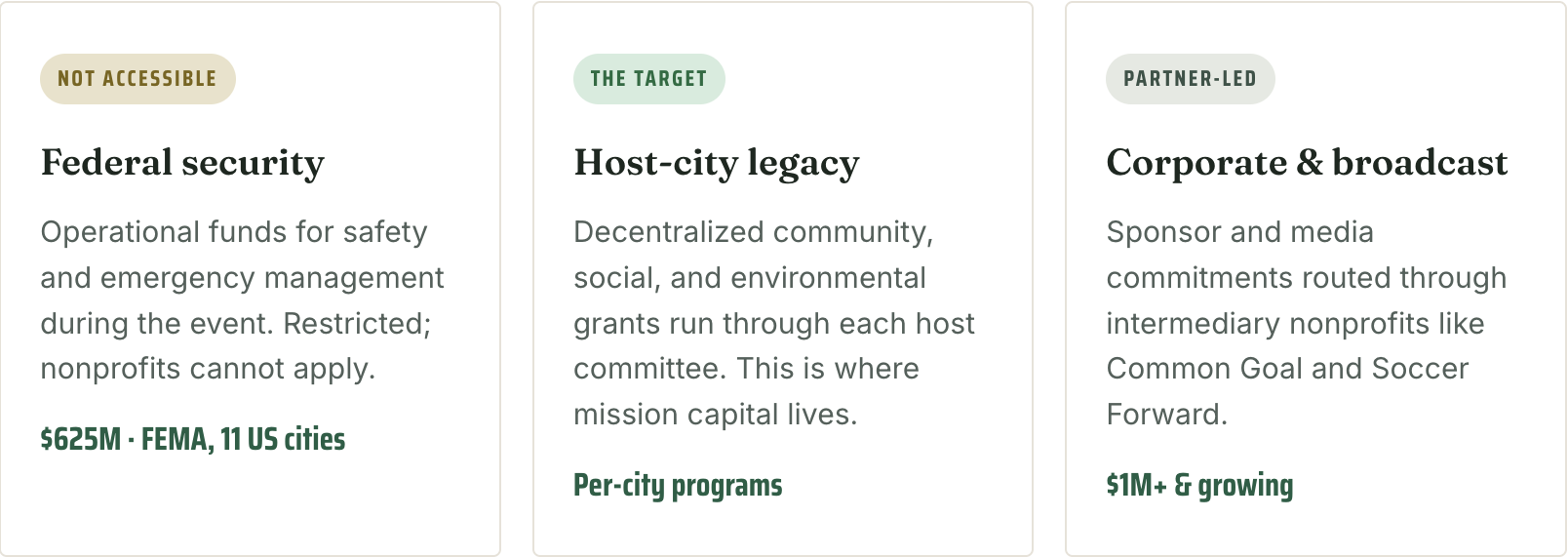
The practical takeaway: chase the decentralized host-city committees, not the federal security pool. The community money is local, time-bound, and tied to each region’s footprint.
Four pillars, and the language funders now expect
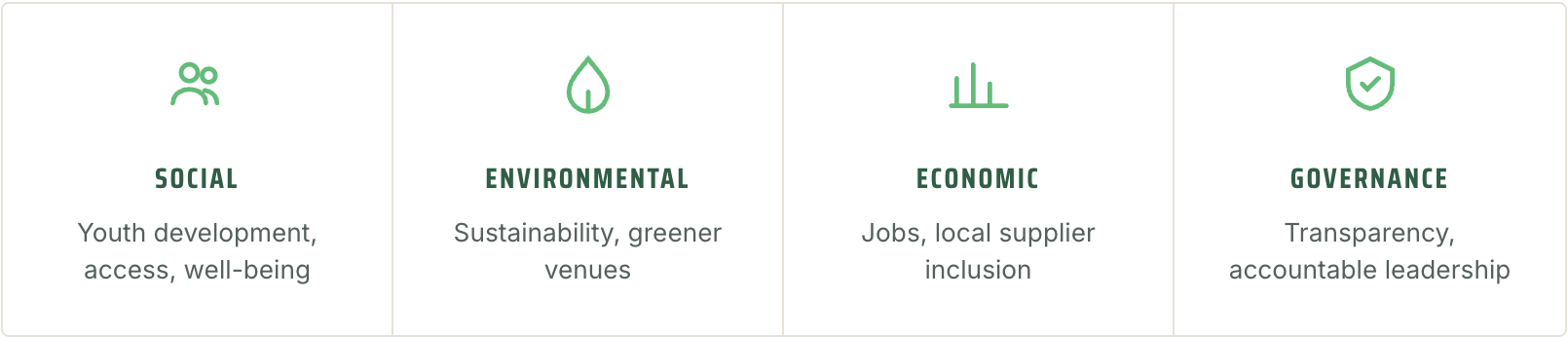
Every funded legacy program is expected to map to at least one of FIFA’s four sustainability pillars. For nonprofits, translating existing work into this vocabulary is often the difference between a fundable proposal and a passed-over one.
On the pitch, in the stands: FIFA’s social campaigns
Beyond the grant money, FIFA is using the tournament’s reach for advocacy. Its flagship Football Unites the World returns, joined this cycle by Unite for Peace — promoted during the group stage with all 48 teams and match officials wearing a sleeve patch — plus Unite for Education, anti-racism messaging, and a youth physical-activity push. Many tie back to the FIFA Foundation’s refugee work, delivered with the UN Refugee Agency.
FIFA is aiming to use football’s unique power to build bridges.— Gianni Infantino, FIFA President
Where the community capital is actually landing
A representative sample of the philanthropic and host-committee commitments announced ahead of and during the tournament. The pattern is consistent: corporate dollars routed through intermediary nonprofits, and host committees standing up their own grant portals.
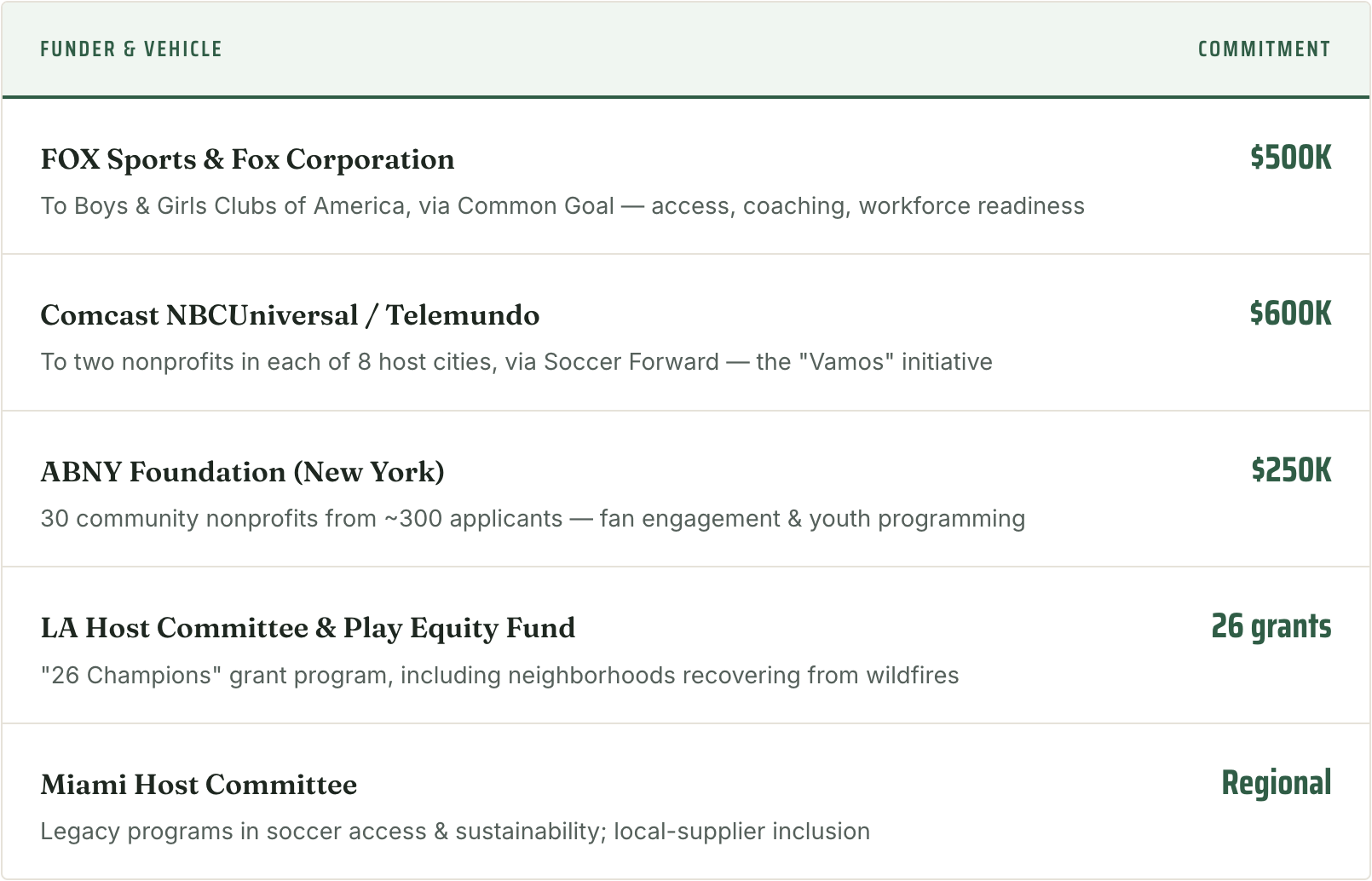
A defining feature of this cycle: the equity lens is explicit. New York’s program gave priority to neighborhoods shaped by historic underinvestment and inequitable health and economic outcomes — a direction echoed across host cities.
The lasting impact it creates in communities nationwide.— Eric Shanks, CEO & Executive Producer, FOX Sports
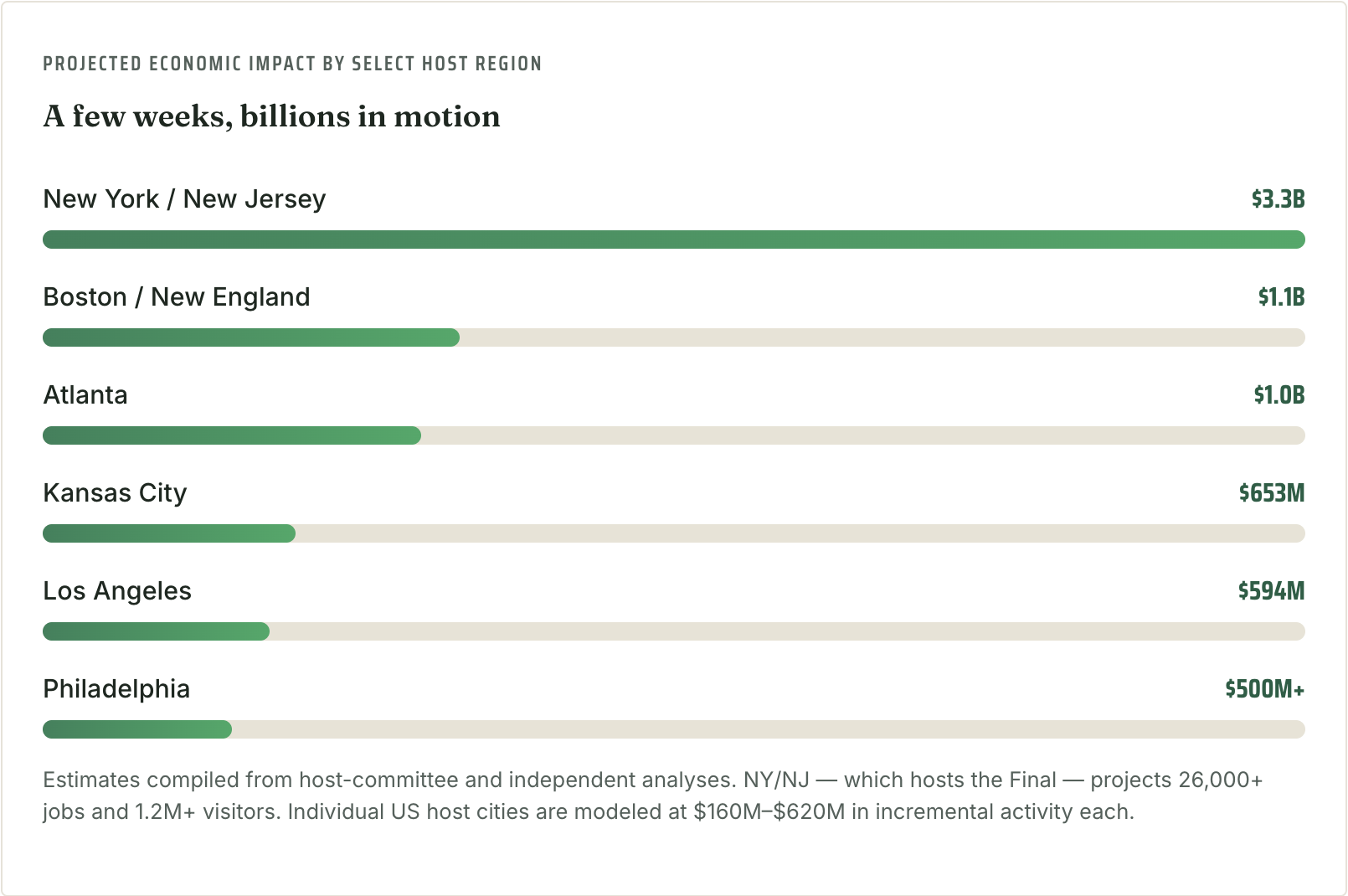
The economic surge that the philanthropy rides on
The tournament unleashes an extraordinary wave of activity into host regions — and that prosperity is a rising tide communities can ride. The opportunity is to channel a share of this energy into programs and partnerships that keep delivering well after the closing match.
Miami’s accountability mandate is an opening
The Greater Miami Sports Commission, operating as the host committee, is building legacy programs around soccer access and sustainability. Crucially, its grants require data collection and economic-impact reporting — and it must deliver a full economic-impact report to Miami-Dade County by January 19, 2027.
That reporting obligation is a tell. Where measurement is mandated, advisory and evaluation support is genuinely needed — and South Florida nonprofits that can speak the language of outcomes, not outputs, are positioned to lead.
For funders and nonprofit leaders: the moves that matter
A catalyst for an enduring, impact-driven legacy.— Lex Chalat, Executive Director, Soccer Forward
For funders and nonprofit leaders: the moves that matter
A catalyst for an enduring, impact-driven legacy.— Lex Chalat, Executive Director, Soccer Forward
-
Go local, go fast
The accessible capital sits with host-city committees, not federal pools, and most of it is time-bound to the tournament’s footprint. Map the committee in your region and its grant calendar now.
-
Translate into the four pillars
Reframe existing programs in the language of Social, Environmental, Economic, or Governance impact. The work may already qualify; the framing is what unlocks the door.
-
Retire vanity metrics
Funders this cycle expect social return on investment and structured logic models — long-term outcomes, not “number of kids who played.” Build the measurement spine before you apply.
-
Lead with equity, by name
Committees are explicitly prioritizing historically underinvested communities. Specificity about who you serve, and the disparity you address, is now a competitive advantage.
-
Plan past the final whistle
The legacy materializes only where infrastructure outlasts the event. Tie tournament dollars to a multi-year continuation plan, not a one-summer activation.
Games with impact on the communities who support
The broadcasters, committees, and global federation describe the same joyful ambition: a tournament measured not by the matches alone, but by the energy, pride, and opportunity it leaves in the communities that welcome the world. The capital is real, the equity intent is genuine, and the goodwill is already reaching neighborhoods across the host regions.
This is a moment to celebrate — and to build on. When communities pair that celebration with vision and continuity, 2026 becomes more than a summer to remember; it becomes a launchpad for a generation of local impact.
A World Cup can fill stadiums for a month. The harder contest is whether the capital it unleashes reaches the neighborhoods that need it — and stays there long after the final whistle. Turning spectacle into durable, community-owned impact: that is the work.
Dwayne AshleyFounder & CEO, Bridge Philanthropic Consulting, LLC
Sources
- FIFA & WTO / OpenEconomics, Socioeconomic Impact Analysis, 2025 — GDP, jobs, and social-benefit projections.
- FIFA, “Social impact campaigns at FIFA World Cup 2026,” inside.fifa.com, 2026.
- FEMA, FIFA World Cup Grant Program, fema.gov, 2026 — $625M security funding.
- Fox Corporation / FOX Sports, community impact announcement, May 2026.
- Comcast NBCUniversal & Telemundo / Soccer Forward, “Vamos World Cup Initiative,” March 2026.
- ABNY Foundation, “World Cup For All Community Grant Program,” 2026.
- Los Angeles World Cup 2026 Host Committee & Play Equity Fund, “26 Champions,” 2026.
- Greater Miami Sports Commission, Local Impact Supplier Program, 2026.
- NY/NJ Host Committee economic impact summary; Boston Consulting Group North America analysis.
- Britannica Money, “Economics of the FIFA World Cup,” 2026.

Download The Free BPC Capital Campaign Guide
Running a capital campaign can be a game-changer for your non-profit organization. This comprehensive guide dissects the process and offers expert advice to help you prepare for a successful capital campaign.

