

Thought Leadership
BPC Insights–Planning for Succession in Your Founder-Led Organization

YOUR ORGANIZATION’S GREATEST ASSET IS ALSO ITS GREATEST RISK. As a founder-led nonprofit or philanthropic organization, your visionary leadership has built something extraordinary. You’ve created mission-driven impact, cultivated donor relationships, and assembled passionate teams committed to systemic change. But here’s the uncomfortable truth: without a solid succession plan, all of that could unravel overnight.
At Bridge Philanthropic Consulting, we’ve witnessed this scenario too many times. Our 800 years of combined experience has shown us that the most successful organizations: those we’ve helped raise more than $2 billion for: share one critical characteristic: they plan for leadership transition before they need it.

“Succession planning isn’t about preparing for your exit,” says Dwayne Ashley, CEO and Founder of Bridge Philanthropic Consulting. “It’s about ensuring your mission survives and thrives beyond any single individual. The communities we serve deserve that continuity of impact.”
START THE CONVERSATION TODAY, NOT TOMORROW
The biggest mistake we see founder-led organizations make is treating succession planning like estate planning: something you’ll get to eventually. But in the philanthropic sector, where trust and relationships drive funding, waiting until you’re ready to step back creates unnecessary risk for your mission.
Here’s what proactive succession planning looks like:
- Begin leadership development within your first five years of operation – Your future successor needs time to build credibility with donors, understand your programs deeply, and develop their own vision for growth
- Create visible pathways for advancement – High-potential team members should see clear routes to increased responsibility, strategic involvement, and leadership roles
- Document your institutional knowledge – Those donor relationships, board dynamics, and program insights living in your head need to be systematized and transferable
- Establish leadership criteria that reflect both heritage and evolution – Honor what makes your organization unique while allowing space for new perspectives and approaches

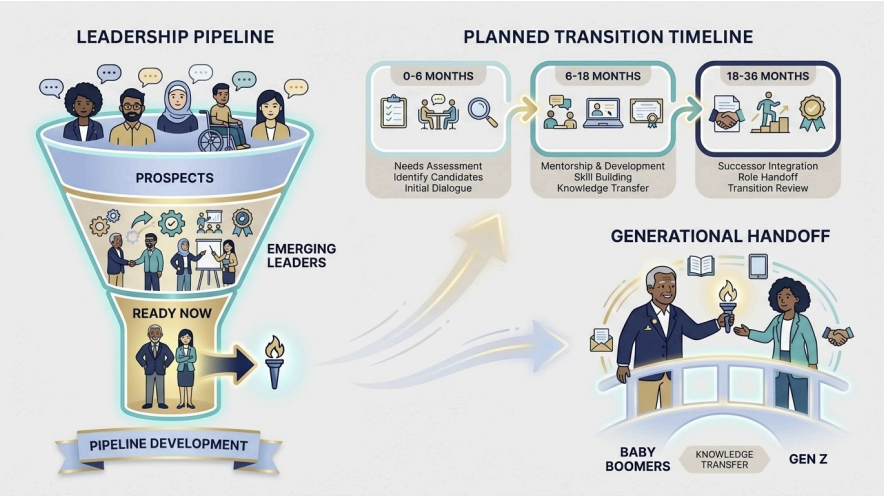
BUILD YOUR LEADERSHIP PIPELINE WITH PURPOSE
In our work with diverse communities and social justice organizations, we’ve learned that succession planning looks different when your mission is rooted in systemic change. You’re not just replacing a CEO: you’re ensuring continuity of values, relationships, and impact.
Your pipeline development should focus on these essential elements:
- Identify 2-3 internal candidates at different stages of readiness – Some may be ready in two years, others in five, but having multiple paths reduces risk and increases opportunity
- Create mentoring relationships that transfer more than skills – The tacit knowledge of navigating donor relationships, board dynamics, and community partnerships requires hands-on guidance
- Provide external exposure and networking opportunities – Future leaders need their own connections in philanthropy, not just access to yours
- Align development plans with organizational growth stages – A startup social enterprise needs different leadership qualities than an established foundation
NAVIGATE THE EMOTIONAL AND CULTURAL COMPLEXITIES
Let’s be honest: founder transitions in mission-driven organizations carry emotional weight that corporate successions don’t. You’ve poured your heart into this work. Your identity may be intertwined with your organization’s success. Donors and community members may see you as irreplaceable.
We help our clients work through these complexities by:
- Establishing clear performance metrics and growth projections – Let data guide transition timing rather than emotions or external pressure
- Creating gradual responsibility shifts – Potential successors can take on donor stewardship, program leadership, or board relations incrementally
- Developing communication strategies for key stakeholders – Donors, community partners, and team members need different messaging about leadership transition
- Planning for founder evolution, not just founder exit – Many successful transitions involve founders moving to board chair, emeritus roles, or specialized functions rather than complete departure

DESIGN YOUR FORMAL SUCCESSION FRAMEWORK
Every organization needs both emergency succession protocols and long-term leadership development strategies. Your formal plan should address three critical scenarios:
Emergency Leadership Transition:
- Interim leadership structure and decision-making authority
- Communication protocols for donors, staff, and community partners
- Operational continuity procedures for ongoing programs and campaigns
- Board activation and oversight processes
Planned Leadership Transition:
- Timeline for candidate development and selection (typically 2-5 years)
- Internal and external candidate evaluation criteria
- Stakeholder engagement and communication strategy
- Transition period structure and founder role evolution
Ongoing Leadership Development:
- Annual talent review and development planning processes
- Leadership competency frameworks specific to your mission area
- Mentoring and coaching program structures
- External development opportunities and professional networks
“Succession is my most important task. The next CEO will need to be prepared for the absence of a safety net and will carry the full weight of decision-making responsibility.” — Jamie Dimon, CEO of JPMorgan Chase (Fortune, May 2025)
Analysts at Wells Fargo and Bank of America emphasize that sustained success is anchored in strong leadership pipelines and confidence in future leadership—regardless of specific successors.
“Enhancing financial literacy and supporting informed decisions about estates and charitable contributions are key for successful transitions.” — National Association of Charitable Gift Planners
“Effective succession planning ensures the sustainability and continuity of your organization’s mission. It’s about identifying and developing future leaders who can sustain impact and nurture resilience through change.” — Dwayne Ashley, CEO and Founder, Bridge Philanthropic Consulting
LEVERAGE YOUR UNIQUE PHILANTHROPIC ADVANTAGES
Unlike corporate succession planning, philanthropic organizations have unique assets that can strengthen leadership transitions:
- Mission-driven talent attraction – People join your organization because they believe in the cause, making them more likely to invest in long-term leadership development
- Board expertise and networks – Your board members often bring significant leadership experience and can provide mentoring, connections, and guidance throughout transition planning
- Donor and community investment – Key stakeholders want your organization to succeed beyond any individual leader and can become powerful advocates for succession planning
- Values-based culture – Organizations built on social impact principles often have stronger internal cohesion and shared purpose that can survive leadership changes

At Bridge Philanthropic Consulting, we understand that planning for succession means planning for sustained impact. Our work with clients across diverse communities has shown us that the most resilient organizations are those that view leadership transition as an opportunity for growth, innovation, and deeper community engagement.
“Succession planning is ultimately about expanding your organization’s capacity for social change,” reflects Dwayne. “When you develop multiple leaders who understand your mission, build relationships with your stakeholders, and bring their own vision to the work, you multiply your impact potential exponentially.”
WE’RE HERE TO SUPPORT YOUR LEADERSHIP TRANSITION JOURNEY. Whether you’re just beginning to think about succession planning or actively preparing for leadership transition, our team brings proven strategies and deep understanding of the unique dynamics facing mission-driven organizations.
Our approach combines strategic guidance with practical implementation support, helping you build leadership pipelines that honor your founder’s vision while positioning your organization for sustained growth and impact. We’ve seen too many vital missions disrupted by unprepared leadership transitions: and too many transformed by thoughtful succession planning.
Ready to start building your organization’s leadership future? Visit Bridge Philanthropic Consulting to learn more about our succession planning services and discover how we can support your mission’s long-term sustainability.
BPC adheres to the highest ethical standards in its work as members of the Association of Fundraising Professionals, Association of African-American Development Officers, and the Giving Institute. Together, we’re building a movement where every organization has the leadership strength to pursue systemic change and social impact for generations to come.

Download The Free BPC Capital Campaign Guide
Running a capital campaign can be a game-changer for your non-profit organization. This comprehensive guide dissects the process and offers expert advice to help you prepare for a successful capital campaign.

